Posts

Winter in Oswego Harbor, 1870s, From Lower Bridge

Image
                      Remembering the good old days on the waterfront                                   By Clark Morrison Oswego Palladium Saturday, April 9, 1887 (Item in weekly column of editor Clark Morrison, Editor, called “Matters of Interest”).    I had a pleasant chat the other day with Captain P. T. O’Connell of San Francisco, California, who is here on a visit to old friends. Captain O’Connell left Oswego 35 years ago for California, where he entered the morning business. He is now engaged in cattle raising.      He finds but few traces now of the Oswego of 1862 and many of his dear old friends of that other daycare now no more. Captain O’Connell found many familiar faces, however, and is having a right royal good time. The Captain has always looked back upon Oswego as “home,” and as the one place in the wo...

'Fitting Out' Great Lakes Schooners

Image
Fitting Out in the Days of Sail By Richard F. Palmer   The Harbor — The work of fitting out vessels preparatory to the opening of spring business has commenced in our harbor, and the sound of the caulking hammer, and the cheery voices of the sailors will be heard again. The work of refitting vessels is fairly begun, yesterday and today being the busiest of the season. Quite a number of vessels are taking on their canvas, and soon our noble blue Ontario will be flecked with snowing sails - We’re glad of it.  - Oswego Palladium, April 8, 1864   The harbor presents a gala appearance today, a large fleet of grain and lumber vessels being in port. Such a forest of spars has not been seen on the river since the good old days of yore, when Oswego rivaled the grain receiving ports of the lower lakes.  Oswego Daily Palladium, May 18, 1874    Oswego residents could sense the navigation season rapidly approaching when sailors left their winter quarters at the lo...

Visit to Sackets Harbor in 1873

Image
  Image from History of Jefferson County by Samuel W. Durant and Henry B. Pierce. Published by L. H. Everts & Co., Philadelphia, Pa., 1878 Cape Vincent Eagle July 24, 1873 What May be Seen at Sackets Harbor                          ___    Sackets Harbor is better known to the world at large for what it was than for it is. During the war of 1813 it was both military and naval head-quarters for operations on the northern frontier and Lake Ontario. Sensible of its importance, the British twice attacked it, and once nearly succeeded in capturing it before they were beaten off. The ruins of the fortifications thrown up at that time, are not yet wholly obliterated. The “oldest inhabitant,” who is a numerous individual, can still point out the bloodiest spots in the fight. In all the region round you will find those who remember hearing the sound of the cannon on one of those eventful days.    Authe...

Steamboat "Lady of the Lake"

Image
 By Richard Palmer  Steamboat Lady of the Lake was built in Oswego in 1842. Sketch by C.H. J. Snider Advertisement for steamboats, Ogdensburg Sentinel, May 30, 1848  Steamboat Lady of the Lake Sailed Lake Ontario and the St. Lawrence By Richard Palmer One of the most popular steamboats on Lake Ontario and the St. Lawrence River in the 19th century was the Lady of the Lake of the Ontario & St. Lawrence Steamboat Company. She launched from the shipyard of George S. Weeks in Oswego on April 28, 1842.  The keel had been laid the previous December. It was described  as “the best steam vessel which floats on our lake.” At that time, steamboat travel on inland waterways was at its zenith. About 300 people went on her initial shake-down trip that June from Oswego to Ogdensburg, a distance of 140 miles, was 11 hours, including three stops, or a running time of eight hours in what was described as rough seas. She was commanded by Captain John J. Taylor. She prov...

Days of the Schooner Fred L. Wells

Image
 Story of the schooner Fred L. Wells by Richard Palmer Prior to 1900 when she ran at Four Mile Point east of Oswego, the two-masted schooner Fred L. Wells  (U.S. #120246) was a familiar sight at Lake Ontario ports. She was easily recognizable by her clipper bow, raking transom, white top, green rails,  covering-board and lead-colored hull. She transported everything from cedar posts and lumber to chestnut coal.  She was a fast sailor and could make the distance between Oswego and Kingston in four hours. Tradition has it this was the last schooner that sailed in and out of Pultneyville in 1881. There appears to have been two vessels named Fred L. Wells . This one was built by A. Frazer at New Jerusalem, Ohio, near Toledo,  in 1875. This is not the current New Jerusalem. This was located here Toledo. She was 90 feet long, had a 22-foot wide deck and hold of seven feet, eight inches, and registered at 94 tons.  She was named for a local state senator. Lat...

How the End of the War of 1812 Was Celebrated

Image
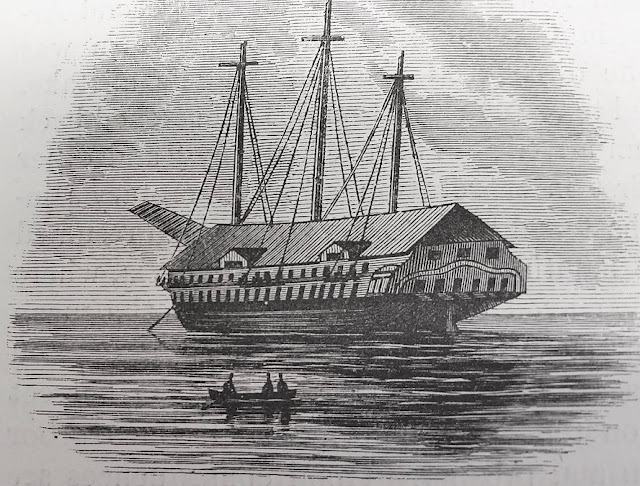
The Superior mothballed at Sackets Harbor. Eventually it was dismantled. From: Lossing’s Pictorial History of the War of 1812) By Richard Palmer The Treaty of Ghent ended the War of 1812 before what could have been a disastrous confrontation occurred on Lake Ontario. As late as February, 1815 there were no less than 600 ship carpenters at Sackets Harbor building warships that could compare with anything built for ocean duty. Its complement was 500 officers and enlisted men. The Superior could cause much damage with its  thirty 32-pounders, two long 24-pounders and twenty-six 42-pounder carronades.  In the northern New York State the War of 1812 was more one of shipbuilding, with each side endeavoring to build the biggest armada of fighting ships ever seen on the Great Lakes.  News of the end of the war was slow to reach Sackets Harbor. But when it did, it was a cause for celebration.  The frigate Superior , which had been launched on May 2, 1814, was ch...